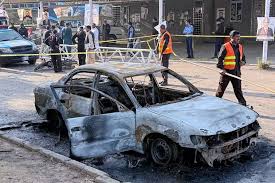
Islamabad, Pakistan – November 12, 2025 – A devastating suicide bombing struck the heart of Pakistan’s capital today, killing at least 12 people and injuring dozens more in what authorities are calling a brazen act of terrorism. The explosion occurred near a bustling marketplace in the diplomatic enclave, sending shockwaves through the city and prompting an immediate lockdown of key government buildings. Eyewitnesses described scenes of pandemonium, with debris scattered across streets and emergency responders rushing to aid the wounded.
The attack, claimed by a splinter group of the Tehrik-i-Taliban Pakistan (TTP), targeted a security checkpoint, according to preliminary investigations by the Interior Ministry. Interior Minister Mohsin Naqvi condemned the incident in a press briefing, vowing swift retribution and enhanced counter-terrorism measures. “This cowardly act will not deter our resolve to eradicate extremism from our soil,” Naqvi stated, as forensic teams combed the site for evidence. The blast’s timing, coinciding with heightened regional tensions, has raised alarms about potential cross-border influences, particularly from Afghanistan where TTP operatives are believed to operate.
Local hospitals were overwhelmed, with reports of critical injuries including shrapnel wounds and burns. One survivor, a shopkeeper named Ahmed Khan, recounted the horror: “There was a loud boom, and everything went dark. People were screaming, running in all directions.” Medical officials confirmed that among the deceased were two police officers and several civilians, including women and children. The Pakistan Red Crescent Society mobilized blood donation drives, urging citizens to contribute amid fears of a rising death toll.
This incident marks the third major attack in Pakistan this year, following similar bombings in Quetta and Peshawar that claimed over 50 lives collectively. Security analysts point to a resurgence of militant activity since the U.S. withdrawal from Afghanistan in 2021, which has emboldened groups like the TTP. “The porous border allows insurgents to slip through, exploiting weaknesses in intelligence sharing,” said Dr. Ayesha Siddiqa, a defense expert based in Islamabad. She emphasized the need for international cooperation, including with India and the U.S., to stem the flow of arms and fighters.
In response, Prime Minister Shehbaz Sharif convened an emergency meeting of the National Security Committee, where discussions focused on bolstering urban surveillance and community policing. The government has also announced financial aid for victims’ families, with compensation packages ranging from 1 million to 5 million Pakistani rupees per affected household. Opposition leaders, however, criticized the administration for intelligence failures, calling for a parliamentary inquiry.
The blast’s ripple effects extend beyond immediate casualties. Economic activities in the capital ground to a halt, with markets closing early and traffic diverted from affected areas. Tourism, already fragile due to ongoing instability, could suffer further setbacks. International reactions poured in, with the United Nations Secretary-General Antonio Guterres expressing condolences and urging unity against terrorism. The U.S. State Department issued a travel advisory, warning American citizens to avoid non-essential travel to Pakistan.
As investigations unfold, questions linger about the bomber’s identity and motives. Preliminary reports suggest the perpetrator was a young male radicalized online, highlighting the growing threat of digital extremism. Cybersecurity experts warn that social media platforms must do more to curb hate speech and recruitment propaganda.
This tragedy underscores Pakistan’s precarious security landscape, where economic woes and political divisions exacerbate vulnerabilities. With elections looming next year, the government faces pressure to deliver on promises of peace and stability. For now, Islamabad mourns, but the path to resilience demands more than rhetoric—it requires actionable reforms to protect its citizens from the shadows of violence.
In a related development, neighboring India expressed solidarity, with Prime Minister Narendra Modi, currently on a state visit to Bhutan, condemning the attack and offering assistance in counter-terrorism efforts. Modi’s trip, aimed at strengthening bilateral ties through hydropower projects, took on added significance amid regional unrest.
As the sun sets on a somber day, the people of Islamabad hold vigils, lighting candles in memory of the lost. The road to recovery will be long, but in the face of adversity, the nation’s spirit endures.